




.webp)
.webp)

.webp)


Key Takeaways
- Heat stroke is the second-leading cause of line-of-duty death for U.S. police K9s, accounting for more than 1 in 5 deaths in an analysis of 407 fatalities between 2000 and 2023 published in Police Practice and Research.
- There is no universal danger temperature for working dogs. Acclimated dogs can run 104 to 108°F during work and recover normally, which is why veterinarians recommend tracking each dog's personal baseline instead of a fixed threshold.
- Body temperature often keeps rising after work stops. In a 2020 study of human remains detection dogs, 95% of individual peak temperatures occurred during post-work recovery, not during the active search.
- DogBase's Health Center now records body temperature as a dog-level history with context tags and optional links to training or deployment records, so handlers can see temperature drift against a personal baseline.
- Weight entries also now count toward account activity metrics in the Health Center, matching how medication and vaccination logs are scored.
Body Temperature Tracking for Working Dogs: Why Heat Records Belong in the Health Center
Body temperature belongs in a working dog's health record as a dog-level history with context tags, because a single reading means very little without a baseline.
Heat injury is the second-leading cause of line-of-duty death for U.S. police K9s, behind gunfire, and a top non-combat killer of military working dogs. Patrol, detection, and search and rescue handlers already take temperatures before, during, and after hot-weather work. Most of them store those numbers nowhere: in a notebook that gets lost, in a memory that fades, or as a one-off field in a training form that was never designed to produce a trend over time.
That absence is the problem. This post covers what the veterinary and operational literature actually says about heat, baselines, and context, then walks through the tracking features we added to DogBase's Health Center because of it.
Why is heat such a deadly problem for working dogs?
The toll is quantifiable. A 2024 study in Police Practice and Research by researchers at Georgia Southern University analyzed 407 line-of-duty K9 deaths from 2000 through 2023 and found heat stroke to be the second-leading cause of death after gunfire, representing more than 1 in 5 fatalities. In 70.6% of those heat deaths, the dog was left unattended or a mechanical air-conditioning failure occurred.
Military data paint the same picture. An analysis of military working dog deaths during Operations Iraqi Freedom and Enduring Freedom, published in Military Medicine, found injuries caused 77% of deaths. Heat stress was the third most common external cause of fatal injury after gunshot wounds and blasts, at 9.8%.
The dog's own drive is part of the problem. Dr. Cynthia Otto, director of the Penn Vet Working Dog Center, puts it directly: working dogs bred for drive will run past their own warning signs because "their drive can override physiological signs that they're getting too hot." Once full heat stroke develops, she puts survival odds at roughly 50 percent.
Danger also arrives quickly. According to a canine heat stroke literature review from Iowa Veterinary Specialties, working dogs can develop hyperthermia in as little as 30 minutes without adequate shade, water, and rest.
Here is where most of the existing safety technology stops. Vehicle cabin heat alarms do essential work and clearly were not enough to prevent the deaths in that 70.6% figure. But they monitor the kennel, not the dog. They capture nothing about the dog that tracked an hour in brush at noon, ran a building search in full kit, or came off a deployment and went straight into a crate. Body temperature history is the layer those systems cannot see.
Why isn't there one temperature that means danger?
Because a number that is normal for one working dog can signal real trouble for another, and the same number can be safe mid-work and alarming at rest.
The resting normal range for most dogs sits around 99.5 to 102.5°F (37.5 to 39.2°C), per the AKC Canine Health Foundation. Heat stroke is clinically defined as a non-pyrogenic core temperature at or above 105.8°F (41°C). At 109.4°F, marked organ damage and high mortality are expected.
Those numbers look clean on paper. Field reality is messier. The United States Police Canine Association notes that many active, acclimated working dogs run 104 to 108°F while working and are medically fine. Dr. Otto describes sprinting sport dogs hitting 105 to 106°F without experiencing heat stroke at all. Racing greyhounds can transiently reach 107.6°F after a race with no signs of heat stroke. And per Today's Veterinary Practice, military working dogs have operated in ambient temperatures up to 140°F without adverse effect.
Meanwhile, an unacclimated dog can be in trouble at the low end of that same working range.
This is why the authoritative recommendation is not "watch for a number." It is "know your dog's number." Dr. Dana Vamvakias, chief veterinarian at K2 Solutions, described the practice to the AKC Canine Health Foundation: K2 personnel take each dog's temperature before training, mid-training, at conclusion, and roughly 30 minutes before kenneling. Once those readings were recorded across enough sessions, handlers learned which dogs run hot and how wide the individual normal ranges really were. She recommends a written chart that logs date, activity, ambient temperature and humidity, and body temperature, so you can find each dog's optimal working range.
Why does context matter as much as the number?
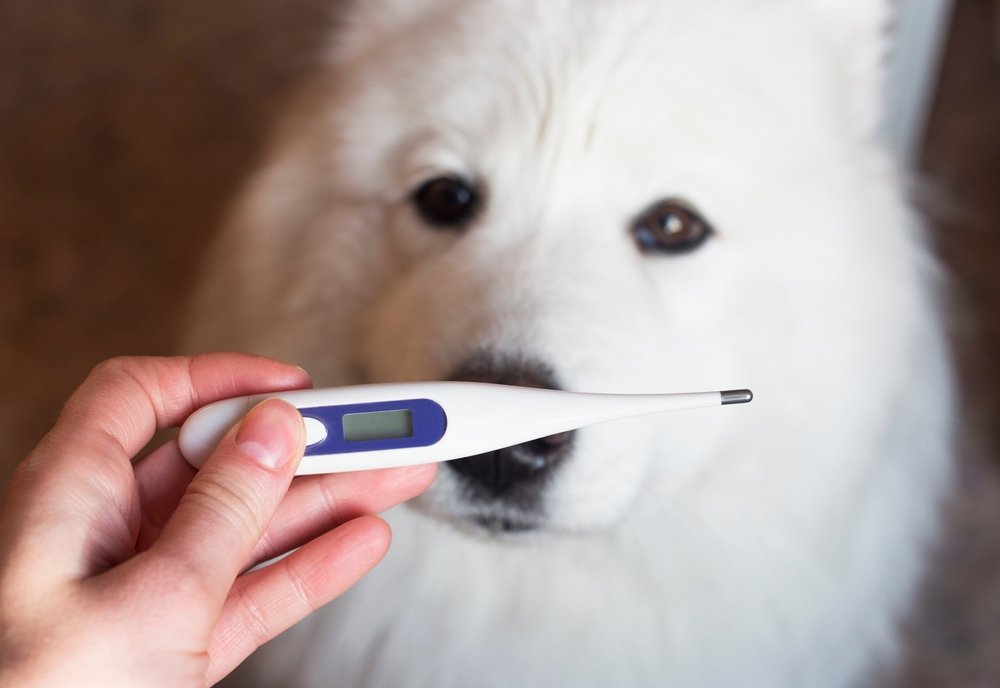
Context decides whether a reading is routine or a warning. A temperature can only be interpreted against what the dog was doing, how hard it was working, what the environment was like, and what that dog normally shows.
The cleanest evidence comes from a 2020 study of human remains detection dogs published in Animals (DOI 10.3390/ani10040673). Researchers measured eight certified HRD dogs with ingestible thermistors across three phases: waiting to work, active searching, and post-work recovery in a kenneled vehicle.
The findings should change how every SAR team logs heat. Mean peak temperature during active work was 39.4°C (±0.34). But body temperature kept climbing after the search ended, rising for a mean of about 6.4 minutes into recovery and peaking higher at 39.66°C (±0.41). Ninety-five percent of individual peak temperatures occurred during the recovery phase, not during active work. The highest single reading in the study, 40.6°C, also came in recovery.
The authors were explicit: the risk of heat injury does not stop when the dog stops exercising, and temperature monitoring should continue after work ceases until the dog's temperature peaks and begins to decline.
That study is the strongest argument for treating temperature as a time-stamped series with phase context. A post-work spike is not a data anomaly. It is the exact event the research says to watch for.
Field data reinforce the point. A separate SAR field study indexed at PubMed Central (PMC7222833) found that rectal temperature and respiratory rate in working search dogs are heavily affected by environmental variables. A bare reading logged without ambient conditions or a phase-of-work tag is nearly impossible to interpret later, and impossible to compare across seasons.
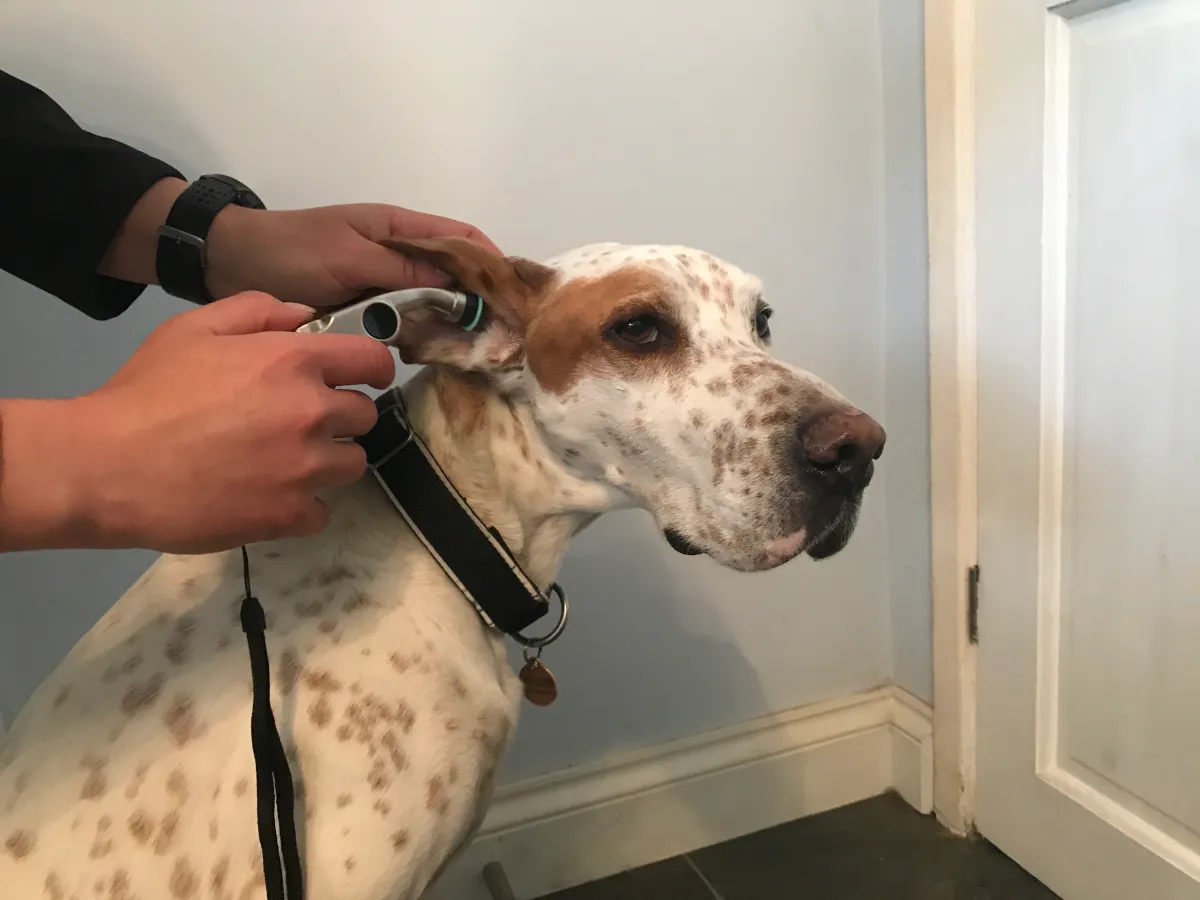
Measurement method matters too. The USPCA is blunt that ear and temporal-scan thermometers are inaccurate in dogs and that rectal measurement is the field standard. A rectal reading and a temporal reading from the same dog at the same moment are not the same data point.
What should body temperature tracking look like in a working dog platform?
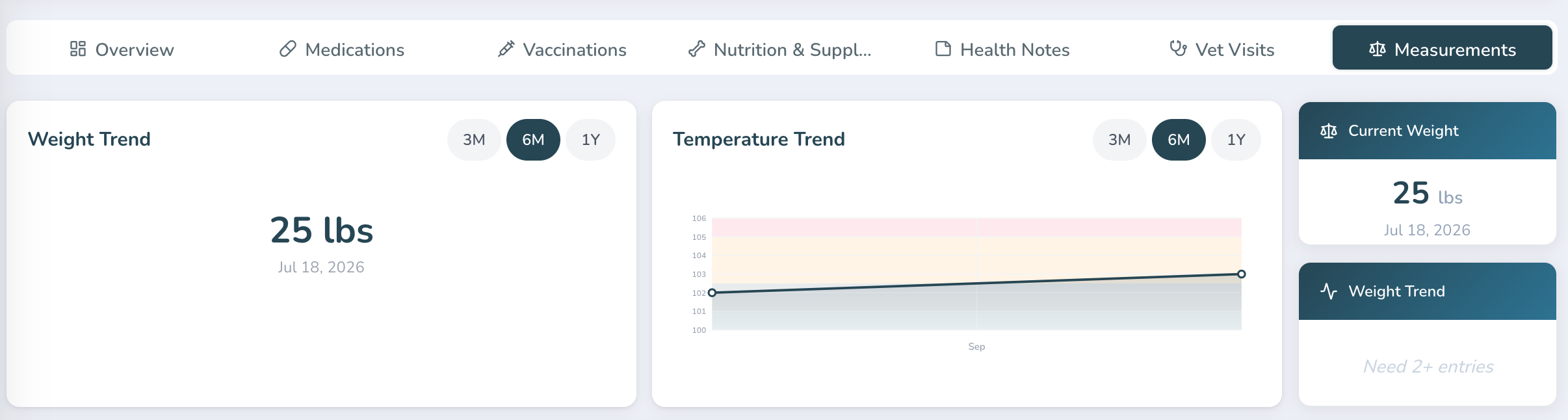
A dog-level longitudinal history with context tagging, not another text field inside a training session form.
The clinical value of temperature lives entirely in trend. You cannot compute a personal baseline or spot a drift from session-siloed data, because the comparison points you need include rest days, illness, and mornings before any work happens. A session-only approach fragments the exact signal that makes the data useful.
Every mature product pattern agrees. Equine health platforms treat temperature, pulse, and respiration as a dedicated vitals tracker charted over time, built to establish a normal baseline so an owner can see how far a horse has drifted from it. Canine apps like DogLog chart weight and temperature over time exactly this way. Human wearables from WHOOP, Garmin, and Oura all compare each reading against an individually learned baseline rather than a universal normal, because a fixed human threshold misleads as often as it helps. Clinical data standards formalize the same shape: in the HL7 FHIR standard, body temperature (LOINC 8310-5) is a point-in-time observation with qualifying context such as measurement method and setting attached. Context is a first-class attribute of a temperature reading, not an afterthought.
The right model is a hybrid. The backbone is a per-dog temperature history. Each entry optionally carries a context tag, ambient conditions, measurement method, and a link to a training or deployment record. The dog's chart shows the full series. A linked session shows its pre- and post-work readings side by side.
What DogBase added to the Health Center

We built the feature the research pointed to. The Health Center now records body temperature as a dog-level clinical history, the same way it already handles weight.
Here is what that means in practice:
- Temperature history in the Health Center. Each reading logs the value and unit (°F or °C) plus a timestamp. The context tag is required and defaults to resting, with options for pre-work, during work, post-work, recovery, cooling intervention, and illness or vet care. A bare number with no context no longer exists in the system.
- Context depth that actually helps interpret a reading. Handlers can attach ambient temperature and humidity, record the measurement method (rectal, validated core device, or other), and add a free-text note. This matches the chart Dr. Vamvakias recommends and keeps the history honest about how each reading was taken.
- Optional session and deployment links. The highest-value working-dog workflow is a pre-work and post-work reading around a hot track or search. When a temperature entry is linked to a training or deployment record, the session page shows the bracketing readings and the delta. That turns temperature into per-session heat-load documentation useful for welfare decisions, after-action review, and liability defense.
- Dog-level charting and baseline visibility. The dog profile shows the full temperature history over time, filterable by context tag. The signal a handler wants is visible at a glance: is this dog's resting pattern drifting, or does this dog always run hotter than the kennelmate?
- Dog sizing for travel. Handlers travel for deployments, competitions, and seminars, and airline and IATA crate sizing requires a dog's height and length. Both fields now live on the dog profile, so the numbers are on hand at booking time and stay with the dog's record.
- Consistent health logging. Weight entries previously contributed nothing to account activity metrics while medication and vaccination logs did. That is now fixed: the action handlers take most often shows up in the metrics leadership sees, matching how other Health Center entries are scored.
We deliberately did not paint a single red line across the app at some fixed temperature. The literature is unanimous that a hard-coded danger threshold will cry wolf on healthy working dogs and miss the unacclimated dog in trouble at a lower reading. When any alerting logic exists, it has to work relative to a dog's own baseline and pair an elevated reading with behavioral guidance, not with a number alone.
A field routine you can start this week
Build the baseline on a cool day, because the entire point is knowing what normal looks like before heat becomes a factor.
Start with morning resting readings. For a handful of non-work days, log a resting temperature at roughly the same time. You will quickly see each dog's personal normal range, and you will see which dogs sit high in the range even before they work.
On work days, follow the protocol K2 Solutions' veterinary staff documented. Take a reading before the session, mid-session when the work allows, at conclusion, and about 30 minutes before kenneling. Attach the context tag and note the ambient conditions for each one.
Keep monitoring after the session ends. Because temperature peaks in recovery, the reading taken after the dog is crated or kenneled is not optional. That is the reading most likely to catch the dangerous climb.
Then compare the readings to the dog's own chart, not to the dog next door. A resting temperature that quietly drifts upward across weeks is a different signal from a post-work spike, and a chart is the only way to see either one in time.
None of this replaces veterinary judgment. It gives you and your vet the one thing you have never had: a recorded picture of what is normal for each dog, and early visibility when that pattern shifts.
Frequently Asked Questions
What is a normal body temperature for a working dog?
A resting temperature between about 99.5 and 102.5°F (37.5 to 39.2°C) is normal for most dogs. Acclimated working dogs routinely run 104 to 108°F during exertion and recover fine, so the more useful number is each dog's individual resting baseline..
When should I take my dog's temperature during hot-weather work?
The documented protocol from K2 Solutions is a reading before training, mid-training, at conclusion, and roughly 30 minutes before kenneling. Add a recovery reading after work ends, because body temperature can keep rising for several minutes after exercise stops.
My dog hit 105°F after a search. Is that heat stroke?
Not by itself. Heat stroke is clinically defined as a non-pyrogenic core temperature at or above 105.8°F (41°C) with supporting clinical signs, and healthy exercised dogs can reach that range transiently. What matters is the dog's behavior, whether the temperature keeps climbing during recovery, and how the reading compares with that dog's usual working pattern.
Can I use an ear or temporal thermometer in the field?
The USPCA advises against ear and temporal-scan devices for dogs. Rectal measurement is the field standard for accuracy. If you use a validated core-temperature device such as an ingestible thermistor, record the method so your history never mixes measurement modalities.
Why track temperature in an app instead of a notebook?
A paper log captures readings, but a digital dog-level history charts them over months, filters by context like resting or post-work, attaches them to training records, and shows when a dog's readings drift from its own baseline. The trend is the signal, and the trend needs a structured history.
What size crate does my dog need for air travel?
Most airlines size IATA-compliant crates from the dog's height and length, with requirements that the dog can stand naturally, turn around, and lie down. DogBase's dog profile now stores height and length so the measurements are on record when you book a flight or order a crate.